
Summary
“Odometer fraud and “salvage titles” are real risks. This guide details how to check used car history in UAE to ensure you aren’t paying top dollar for a damaged vehicle.”
Buying a used car is one of the smartest financial decisions you can make in Dubai. You avoid the steep depreciation of a new car and get a high-quality vehicle for a fraction of the price. However, the used car market can also be a minefield for the unprepared.
We have all heard the horror stories: a buyer purchases a stunning-looking SUV, only to discover a month later that the odometer was rolled back by 100,000 km, or worse that the car was declared a “total loss” in an accident three years ago and cheaply repaired.
To protect your investment and your safety, you need to know how to check used car history in UAE.
Fortunately, the UAE government has made this process incredibly transparent. Unlike many other countries where data is hidden, the UAE’s Roads and Transport Authority (RTA) and Ministry of Interior (MOI) provide digital tools that allow you to investigate a car’s past before you hand over any cash.
In this 2026 guide, MMD Cars Dubai will walk you through the exact steps to verify a vehicle’s history, ensuring you drive away with a deal, not a disaster.
Why Checking Car History is Non-Negotiable
Before we get into the “How,” let’s briefly touch on the “Why.” Skipping a car history check is a gamble you cannot afford to take.
- Safety Integrity: A car involved in a major chassis accident may look fine on the outside, but its structural integrity is compromised. In a future collision, the airbags may not deploy correctly.
- Resale Value: A car with an accident history is worth 30% to 40% less than a clean car. If you pay full price for an accident-damaged car, you are immediately losing money.
- Odometer Fraud: Unscrupulous sellers sometimes “clock” the mileage to increase the price. A history check can reveal the true mileage recorded during previous years.
- Flood Damage: With recent weather events in the UAE, “flooded cars” are entering the market. These often have chronic electrical issues that are impossible to fix permanently.
Step 1: Find the Chassis Number (VIN)
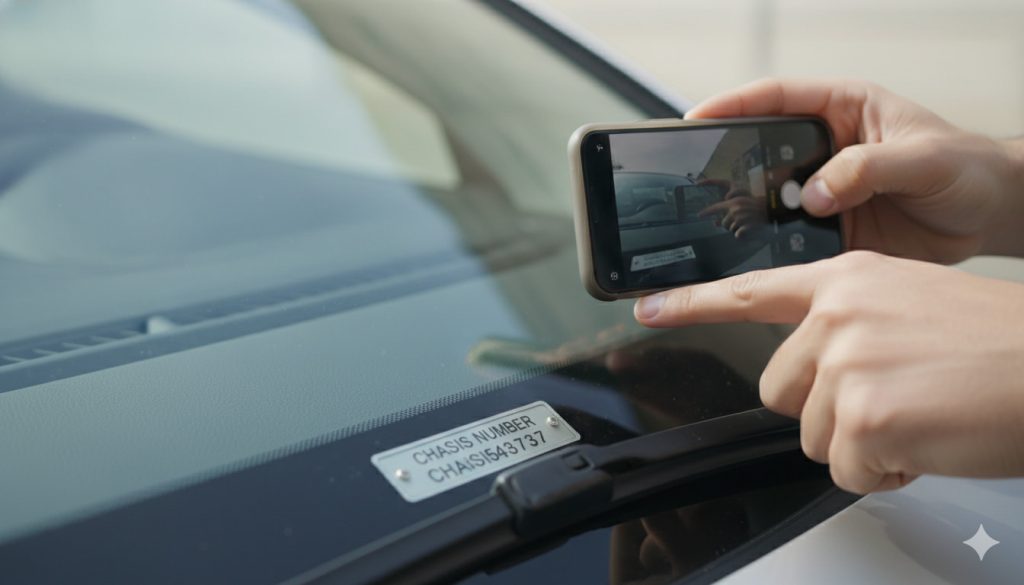
You cannot perform a proper history check with just the license plate number. You need the Chassis Number, also known globally as the Vehicle Identification Number (VIN).
Where to find it:
- On the dashboard (visible through the bottom of the windshield).
- On the driver’s side door jamb sticker.
- On the vehicle registration card (Mulkiya).
Tip: Always take a photo of the VIN when viewing a car.
Method 1: Ministry of Interior (MOI) Website (Free & UAE Wide)
This is the quickest, easiest, and most important step. The Ministry of Interior maintains a federal database of police accident reports across all seven Emirates (Dubai, Abu Dhabi, Sharjah, Ajman, etc.).
How to check used car history in UAE via MOI:
- Visit the official Ministry of Interior (MOI) website or download the MOI UAE app.
- Navigate to E-Services > Public Services > Traffic Accidents Inquiry.
- Enter the Chassis Number (VIN) in the search box.
- Click Submit.
What the results mean:
- “No Records Found”: This means the car has no police-reported accidents. (Note: It could still have minor scratches fixed privately).
- List of Accidents: It will show the date, location, and severity of the accident.
- Minor Accident: Bumper-to-bumper hits, scratches. Usually fine if repaired well.
- Severe Accident / Total Loss: Walk away immediately.
Cost: Free.
Method 2: Emirates Vehicle Gate (EVG)
Emirates Vehicle Gate (EVG) is a centralized portal that links insurance companies and traffic departments. It is particularly useful for checking if a car has insurance claims against it.
How to use EVG:
- Go to the EVG Website.
- Look for the “Traffic Accidents Management” section on the homepage.
- Enter the Chassis Number.
- View the report.
Sometimes, EVG data correlates slightly differently than MOI data, so we recommend checking both to be 100% sure.
Cost: Free.
Method 3: RTA “Technical Vehicle Status Certificate” (Dubai Specific)
If the car is registered in Dubai, the RTA vehicle check offers the most detailed history report available. However, unlike the MOI check, this is not open public information; it requires the owner’s consent.
What is the Technical Vehicle Status Certificate?
It is a comprehensive report that pulls data from the RTA’s testing centers (Tasjeel/Shamil).
What it reveals:
- Odometer History: It shows the mileage reading from every annual registration test.
- Example: If the 2024 test shows 150,000km, but the car is being sold today with 80,000km, you know the meter has been rolled back.
- Number of Previous Owners: Has the car had 1 owner or 7 owners?
- Inspection History: Did the car fail the annual test previously? Why?
- Import Info: Was it imported or bought new in the UAE?
How to get it:
- Visit the RTA Website or App.
- Look for “Technical Vehicle Status Certificate.”
- You will need the Chassis Number and the Current Owner’s Mobile Number.
- The system sends an OTP (One Time Password) to the owner. They must give this to you to authorize the check.
- Pay the fee (approx AED 120).
If a seller refuses to give you the OTP for this certificate, consider it a red flag.
The “Import” Trap: Checking US & Japan Spec Cars
This is a critical point for buyers in 2026. A large percentage of cars in the UAE used market are American Specs or Japanese Specs.
The Loophole:
The MOI and RTA systems only record accidents that happened inside the UAE.
If a car was totally destroyed in a flood in Texas, shipped to Dubai, and repaired here, the MOI website will say “No Records Found.”
How to check Import History:
For any car that is not GCC Specs, you must check its international history.
For US/Canada Specs: Use CarFax or AutoCheck.
- Enter the VIN on their website.
- Pay the small fee ($20-$40).
- Look for “Salvage Title,” “Junk Title,” or “Flood Damage.”
For Japanese Specs: Look for the Auction Sheet.
- Every car leaving Japan has an auction grade (Grade 4/5 is good, Grade R is repaired accident).
- There are websites online where you can retrieve the auction sheet using the Chassis number.
At MMD Cars, we strictly identify the origin of our cars. If we sell an import, we ensure it has a clean title, but we always encourage buyers to verify.
Digital vs. Physical: The Role of Comprehensive Inspection
Knowing how to check used car history in UAE digitally is Step 1. Step 2 is the physical check.
Why? Because a car owner might have hit a wall in their villa, reversed into a tree, or scraped a pillar and fixed it at a cheap garage in an industrial area without calling the police. This will not show up on MOI or RTA reports.
The Solution: The Comprehensive Test
Do not confuse the “RTA Registration Test” with a “Comprehensive Test.”
- RTA Registration Test (AED 170): This is mandatory for transferring the car. It only checks basic safety (brakes, tires, lights) to ensure the car is road legal. It does not check engine health or previous accidents.
- Comprehensive Test (AED 400 – 600): This is a voluntary test offered by Tasjeel or Shamil. They put the car on a lift, check the chassis for welding marks (signs of major repair), test the engine compression, check the gearbox, and look for repainted panels.
Always request a Comprehensive Test for any used car inspection.
Red Flags to Look For (Visual Car History Check)
Even before you pay for a test, you can spot bad history with your own eyes if you know where to look.
Panel Gaps: Look at the gaps between the door and the fender. Are they even? If the gap is wide at the top and narrow at the bottom, the panel was likely replaced or realigned after a crash.
Paint Texture: Look at the reflection of the paint. Does it look like “orange peel” (bumpy)? Original factory paint is smooth.
Seatbelt Labels: Pull the seatbelt all the way out. At the bottom, there is a fabric label. It has a manufacturing date.
The Logic: If the car is a 2019 model, the seatbelt should be dated 2018 or 2019. If the seatbelt is dated 2021, why was it replaced? Usually, because the airbags deployed in a crash, and the seatbelt tensioners locked up.
The Dashboard: When you turn the key (ignition on), all the lights (Engine, ABS, Airbag) should glow. If the Airbag light doesn’t turn on, the seller might have disabled the bulb to hide a fault.
How MMD Cars Handles Vehicle History
We know this process sounds exhausting. Checking websites, paying for reports, arguing with sellers about OTPs… it is a lot of work.
That is why buying from a reputable dealership like MMD Cars is the safer, stress-free option.
- Pre-Checked Inventory: We perform these history checks before we even buy the car. We don’t stock cars with chassis damage or rolled odometers.
- Transparency: We provide the VIN number openly. We invite you to check it.
- Import Integrity: For our imported stock, we ensure clean titles and provide relevant history information.
- Inspection Friendly: We are happy to take any car to Tasjeel for a comprehensive test with you.
Frequently Asked Questions (FAQ)
Q: Can I check the car history using just the plate number?
A: No. Plate numbers belong to the owner, not the car. They change when the car is sold. The history is tied to the Chassis Number (VIN), which stays with the car forever.
Q: Is the MOI accident check completely reliable?
A: It is reliable for police-reported accidents. However, it misses minor unreported accidents or damage repaired privately. This is why a physical inspection is still necessary.
Q: What does “Chassis Embossed” mean on a test report?
A: If a comprehensive test says “Chassis Embossed” or “Chassis Fixed,” run away. This means the car’s main structure was bent in a heavy crash and hammered back into shape. The car is unsafe.
Q: Does RTA check provide owner details?
A: No. For privacy reasons, the RTA report will tell you how many owners the car had, but it will not give you their names or contact details.
Q: Is it illegal to sell a car with accident history?
A: It is not illegal to sell a repaired car, but it is illegal to conceal the history or tamper with the odometer to deceive the buyer.
Conclusion
Knowledge is power. Now that you know how to check used car history in UAE, you can browse the market with confidence.
Remember the golden rule: Trust, but Verify.
- Check the MOI website for accidents.
- Check EVG for insurance claims.
- Get the RTA Certificate for mileage verification.
- Check CarFax for imports.
- Perform a Comprehensive Test.
If a seller tries to stop you from doing any of these steps, walk away. There are plenty of good cars out there.
Want to skip the hassle?
Visit MMD Cars Dubai. We do the hard work for you, offering a selection of inspected, reliable used cars with transparent histories. Drive safe and buy smart!